
The entire IT world is abuzz with talk of Cisco’s Unified Computing System (UCS). I pointed out a few of the various UCS announcements in this earlier post, and now I’d like to just expand a little bit upon the solution.
UCS essentially consists of 4 major components:
- The UCS 6100 Series Fabric Interconnect devices, running Cisco UCS Manager
- The UCS 2100 Series Fabric Extender, with up to 2 of them running in each chassis
- The UCS B-Series blades, either half-width (8 blades per chassis) or full-width (4 blades per chassis), and up to 40 chassis per system
- UCS network adapters supporting DCE/CEE/DCB and FCoE, apparently coming in three different flavors (efficiency/performance, compatibility, and virtualization)
This diagram shows an overview of UCS:
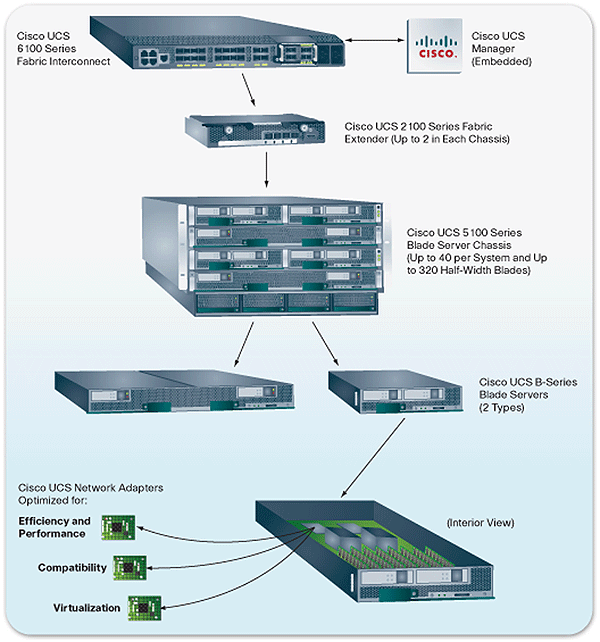
With the exception of the UCS Manager software and the Converged Network Adapters (CNAs), everything else is pretty standard stuff:
- The UCS 6100 is essentially a Nexus 5000, but with the ability to run the UCS Manager software.
- The UCS 2100 is essentially the same as the Nexus 2000 Fabric Extender (FEX), but in a form factor that is intended to plug into the UCS chassis.
- The B-Series blades are industry standard blades running Intel Nehalem CPUs, standard hot-plug hard drives, and 10Gb CNAs.
The CNAs appear to be one area in which there may be some innovation. In particular, the virtualization-optimized CNA appears to extend some new functionality into the virtualization layer itself, although it’s currently unclear exactly how, or how the virtualization layer will leverage that functionality. It sounds like SR-IOV to me, but others are indicating that it’s an offshoot of Intel’s VT-d technology. Speaking specifically with regard to VMware ESX/ESXi, I would guess that this will need to be combined with VMDirectPath, as it appears to replace the need for the vSwitch within the ESX/ESXi host. Personally, I’d rather not replace the vSwitch and instead allow the UCS 6100 and/or UCS Manager to manage Nexus 1000V VEMs on the ESX/ESXi hosts instead. This will truly bring unification without adding complexity.
The real wildcard here is UCS Manager. Although the Cisco webcast spoke frequently of the “open APIs” and “XML APIs” that other partners can leverage, but nothing substantial or significant was released regarding UCS Manager. Lots of questions have yet to be answered, but the one that really jumps out at me is this one:
How will an organization need to organize their storage in order to take advantage of UCS?
I’m guessing here that organizations will need to do boot-from-SAN in order to gain the true flexiblity and agility that UCS is supposed to provide. In that case, what Cisco is supplying is not that dramatically different from a multi-vendor solution that utilizes something like Scalent to provide automation. Of course, Cisco’s solution is from a single vendor and is supposedly more integrated.
So, there are my initial thoughts. What about you?
Tags: Cisco, FCoE, Hardware, Networking, Virtualization
-
Much adieu about nothing to me. I also think it’ll be done before it’s gotten off the ground if they’re really tying themselves as tightly to EMC as EMC claims.
Also, I’m on the same page as you… they’ve essentially told us nothing so far. What will make or break this is the software, which we haven’t so much as seen a screenshot of. If the software sucks, this will be no better, and possibly worse, than sourcing from multiple vendors.
-
Scott - the adapter virtualization isn’t based on SR-IOV (or MR-IOV), but instead is the untold story here, IMHO.
The network adapters have their own discrete roadmap over the next few months (and all need to consider that Cisco couldn’t say everything before the official Nehalem launch also gang). The initial shipping adapters don’t have Cisco’s full sauce, the followon (very close) Palo adapters do. It’s extensions to the ethernet frame standard (being submitted to the standards bodies)
When I was first disclosed on this about a year ago the VN-Link idea - the funny thing was the design point was the UCS design - the ability to have NO distributed switch in the vmkernel, but carry the vnic MACs external to the hypervisor per se. As a side effect, the bonus was that you could p-to-v a Nexus and get the N1Kv (instead of using VN-link to carry the virtual MAC to an external switch, it goes to a VM). Of course, everyone was so pumped about the N1Kv (which is very cool), that generally people missed the other design point.
That describes the “adapter virtualization” for the ethernet stack, there’s similar stuff for the FC part of the FCoE equation.
Re closeness with EMC, speaking with some authority here Tim - we are VERY close on this - but I am making no implications of exclusivity (and I don’t think anyone is - or should be).
The Cisco crew aren’t tightly linked with any one party in the whole stack - we are dead serious about “openness and choice” in this effort (no one wants things that limit choice). Just like our efforts with VMware in general, EMC must win on our own merits. What I can say is that there is a geniune shared vision of all three companies, and that our resource investments and focus are… substantial. There’s also a certain element of this which is non-technological.
-
The non-technological point is that virtualization as a whole - and UCS is a manifestation of this - crosses functional organizational boundaries of application/OS/server/network/storage.
We’re increasingly finding these are CIO-level discussions (actually was asked almost this exact way by during the exec/analyst call), and Cisco, VMware, EMC - along with HP, IBM and Microsoft, but few others operate in the technical realm, but are strategic vendors for the largest customers.
In the mid-market - there aren’t the same organizational boundaries (for better and for worse)
-
And since a bunch of 3 incoherent comment posts aren’t enough
While more customers choose EMC for their storage than anyone else, and our share continues to grow, with strong margins (aka we must be doing SOMETHING right
- even if you aren’t an EMC storage customer or an EMC fan in general, there’s also another dimension.As Ed Bugnion and I (along with Scott Davis from VMware) covered at VMworld in Cannes here (see about mid-way through TP03). The recorded session is here: http://virtualgeek.typepad.com/virtual_geek/2009/03/vmworld-europe-2009-emc-post-show-report.html
Take a look at that session today based on today’s announcement. You’ll see this is far more than a server announcement, it’s about a lot more than 10GbE and FCoE. Ed also does an interesting thing halfway though as he points out that our partnership isn’t the simple model people think of on the surface. Cisco uses RSA and EMC Smarts (as an OEM), Cisco and EMC have embedded code in the vmkernel of the vSphere release, VMware is used extenisvely all over the stack (including Cisco and EMC VM appliances).
Every customer needs to make their own choice - but the depth of integration is substantial - more than just Paul and Joe being part of the launch webcast.
-
You’re absolutely right on the storage side. That’s the biggest and most complex component in the Enterprose Datacenter today, that Cisco didn’t include in their UCS offering as a component to make it truly Unified.
The same solution one can (with or without help of System Integrator) achieve today by using components. Their software can make some difference, but it’s still a question. -
Trying to be more coherent, less rambly here in the morning - from my exposure to it, VN-Link is an extension to ethernet that extends the ethernet frames from the VM itself via the extender to the 6100. Palo is an SR-IOV adapter that allows for a large number (128 was the spec I saw) multiple virtual interfaces (which is particularly important for the FC side of FCoE).
We’ve got a bunch of UCS systems - they’ve been in elab for a while - I’ll check it out and double confirm.
-
Scott,
VN-Link is an umbrella Cisco marketing term that describes granular per virtual machine visibility and policy control. VN-Link can be accomplished in two ways, 1) via software with Nexus 1000V, 2) via Hardware with VN-Tags and SR-IOV.So, VN-Link is not different than VN-Tag — rather, VN-Tag is one way to achieve “VN-Link”.
With Cisco UCS and the Palo adapter, you will be able to achieve “Hypervisor Bypass” (VM Direct Path), where the VM writes directly to its SR-IOV slice of the adapter. The adapter then applies a VN-Tag to uniquely identify the “virtual NIC” the traffic belongs to — VN-Tag acts like a virtual patch cable running from the SR-IOV adapter to the UCS 6100 fabric switch. At this point the virtual machine is managed as if it is connected directly to the UCS 6100 fabric switch.
Another advantage is much better network I/O performance for virtual machines, more like bare metal. The hypervisor is no longer context switching the data from a vNIC buffer to the adapter buffers, reducing latencies, and improving throughput. Furthermore, given the hypervisor CPU is freed from network I/O responsibilities, you can give back precious CPU cycles for hosting more virtual machines.
Hope this clarifies.
Brad
-
I think it’s important to note that in all this discussion of SR-IOV, VN-Tag, VT-c, VT-D (and the rest of the alphabet soup) there is nothing that other vendors can’t leverage (assuming VN-Tag is standardized). In fact, HP is already offering an SR-IOV 10 GbE adapter for it’s C-class blades and has been doing so for 6 months. So at the end of the day it will come down to who makes this stuff the most transparent to poor sys admins tasked with tying it all together.
-
Brad - one thing to clarify my SR-IOV comment - SR-IOV is dependent in VMware land to use of VMDirectPath IO (which in gen 1 has significant limits, designed to be lifted in gen2). Cisco has been working with VMware to have a slightly accelerated functional capability here (using the underlying SR-IOV model) prior to VMDirectPath IO gen2.
-
One aspect that was touched on but is still not clear to me is the compatibility of VMDirectPath and vMotion. VMDirectPath presumably interfaces directly with the native VF (sr-iov virtual function, ie a physical interface). vMotion is possible because ESX was abstracting physical I/O interfaces used by the VM. How is vMotion accomplished if the VM is accessing the native/physical interface directly?


19 comments
Comments feed for this article
Trackback link: http://blog.scottlowe.org/2009/03/16/more-on-cisco-ucs/trackback/